Electrical Engineering
The department has a very valuable heritage of teaching and research and is widely known to be a leader in Electrical Engineering education in central India. The faculties of the department continuously carry out research on the latest technologies.
Vision & Mission
Mission Statement :
The mission of the department is to achieve the following goals :
- Provide high quality innovative educational programs at the undergraduate and graduate level.
- Prepare graduates for the high technology field by promoting lifelong learning, technical expertise, ethical standards, and leadership qualities.
- Pursue excellence in scholarly research at the frontiers of electrical engineering.
- Commit our faculty expertise and modern facilities to the service of the industry, the profession, and other constituents in the state and the nation.
Vision Statement :
The Department of Electrical Engineering is committed to innovation and excellence in teaching, research, and service. We plan to achieve this vision by recruiting high caliber faculty and students, and by continually improving our curriculum and teaching methods. The department facilitates a collegial atmosphere that is conducive to intellectual and scholarly pursuits of faculty and students.
Program Outcomes
- PO1- Ability to apply knowledge of mathematics, science, Computer Science, electronics, and electrical engineering.
- PO2- Ability to design electrical and electronics circuits and conduct experiments with electrical engineering as well as to analyze and interpret data.
- PO3- Ability to design digital and analog system pertaining to electrical systems.
- PO4Ability to visualize and work on multi-disciplinary tasks.
- PO5-Ability to identify, formulate and solve engineering problems.
- PO6- An understanding of professional and ethical responsibility.
- PO7- Ability to communicate effectively in both verbal and written form.
- PO8- Ability to develop confidence for self-education and to understand the value of life-long learning.
- PO9- Ability to recognize the impact of engineering on society.
- P10- Ability to acquire new knowledge to use modern engineering tools, software, and equipment to analyze problems necessary for engineering practice
- P11- A Knowledge of contemporary issues to undertake innovative projects.
- P12- Ability to use the techniques and skills to face and succeed in competitive examinations like GATE, GRE, TOEFL, GMAT, etc.
The curriculum for ELECTRICAL Engineering is set by R.G.P.V University BHOPAL. The courses in the curriculum are such that they satisfy all the objectives and outcomes defined for the program.
Program Specific Outcomes
By the end of the educational experience our students should have learned to:
- Able to utilize the knowledge of high voltage engineering in association with power systems in an innovative, dynamic, and challenging environment, for research-based teamwork.
- Can explore the scientific theories, ideas, methodologies, and the new cutting edge technologies in renewable energy engineering, and use this erudition in their professional envelopment and gain sufficient competence to solve the current and future energy problems universally.
- With an understanding of technologies like PLC, process controllers, and microcontrollers, one can analyze, design electrical and electronics principles to install, test, maintain power systems and applications.
Program Education Objectives
The educational objectives of the Undergraduate Programs of ELECTRICAL Engineering are:
- PEO1- To prepare students to outshine in industry /technical professions or postgraduate programs through quality education.
- PEO2 – To offer students with the knowledge of Basic Sciences in general and specialization in Electrical and Electronics Engineering to impart the necessary skills for analyzing, designing, and synthesizing electrical circuits, and algorithms to create novel products.
- PEO3- To prepare students to identify and select modern electrical engineering tools to enhance power generation, transmission, and distribution.
- PEO4- To prepare students to establish and manage minor and major projects in groups based on innovative ideas for sustainable development and solutions for real-life problems.
- PEO5- To pound students with professional skills, effective communication, teamwork ability, a multidisciplinary approach, and an ability to relate engineering issues to a broader social context.
Key Features
Our department is well furnished with all the required equipment and lab facilities as per AICTE norms. Here-under is the details:
- Electrical Instrumentation Lab
- Network Analysis Lab
- Power Electronics Lab
- Control System Lab
- Switch Gear & Protection Lab, etc.
These provide a better understanding of the subjects with a practical approach and in understanding the applications of the technology in a realistic model.
Programs Offered
- B.Tech
- Diploma in EE
Departmental Achievements
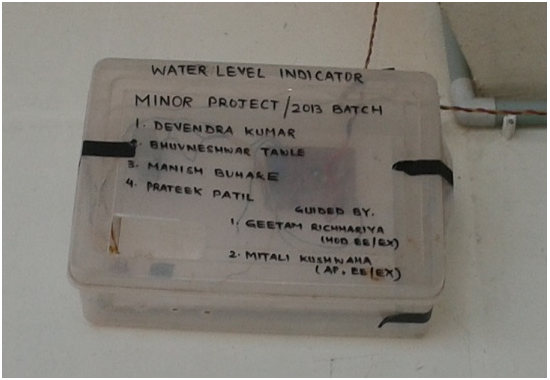
- Water level indicator (Installed in between water tank (at the roof of NIRT) to Admin office NIRT; It sends alarm during overflow (water) condition). Prepared by Bhuvneshwar, Devendra, Manish Buhare, Pratik Patil under the guidance of Prof. Geetam Richhariya and Prof. Mitali Khushwaha.
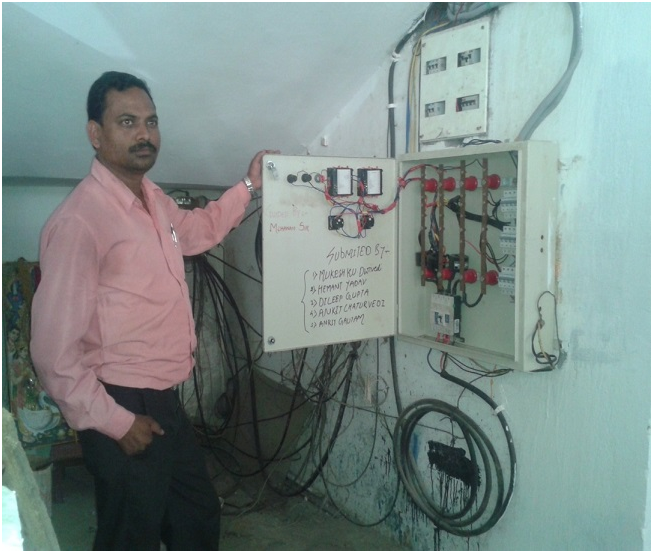
- Three-phase control supply (Installed at NVISMT Building controlling 3 floors) – Made by Mukesh & group, Hemant, Dileep, Ankit Chaturvedi, and Ankit Gautam under the guidance of Prof. R.M Patil and Mr. Moahana.
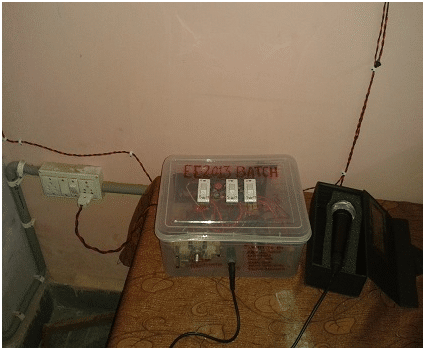
- Electronic speaker system (Installed at EE Deptt- It sends voice notices to the 3 classrooms of the department) Prepared by Deepak, Tanisha, Anoop, Kajal, Rohit under the guidance of Prof. Geetam Richhariya and Prof. Samar Jeet Shukla.
- PV stand-alone system (Installed at EE/EX Deptt). It illuminates the even when power is cut off due to renewable energy sources). Prepared by Abhishek Anand, Abhishek KR, Anil Pal, Neeraj, Pravendra, Amit Meena under the guidance of Prof. Geetam Richhariya and Prof. Anurag Singh Thakur.
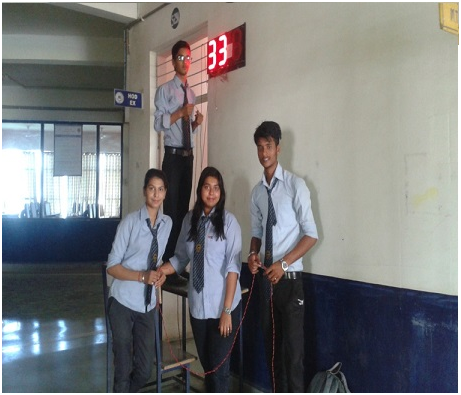
- Automatic temperature sensor (Installed on the second floor of NIRT- Sensing and indicating the environmental temperature)
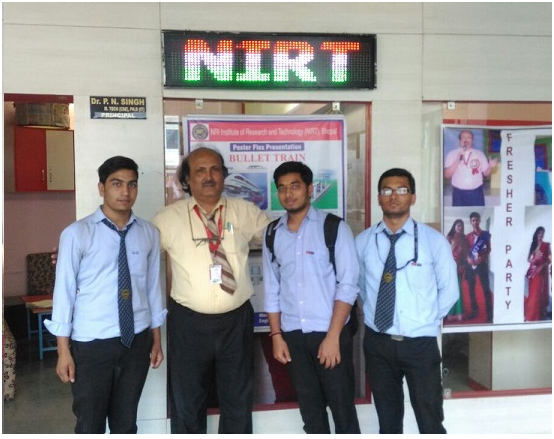
- Moving message display device “DIRECTOR NIRT” (Installed at Director NIRT Office- highlighting the cabin of Director NIRT from remote). Prepared by Harsh Malviya, Puspa Solanki, Ajay, Shivam Gupta, Gopal Kr. Under the guidance of Prof. Geetam Richhariya and Prof. Rakhi Yadav.
- Smart City Model – It includes all the automatic controlling like water level indicator, fire alarm, etc) and also shows the use of renewable energy sources to save energy. Raj, Neha, Ankita, Himanshu, Vivek Under the guidance of Prof. Geetam Richhariya, and Prof. Samar Jeet Shukla.